Home battery backup in a power cut: what it covers
A full battery in a dark house surprises a lot of people. The reason is a safety rule, not a fault, and the fix is a backup function that has to be designed in.
In short
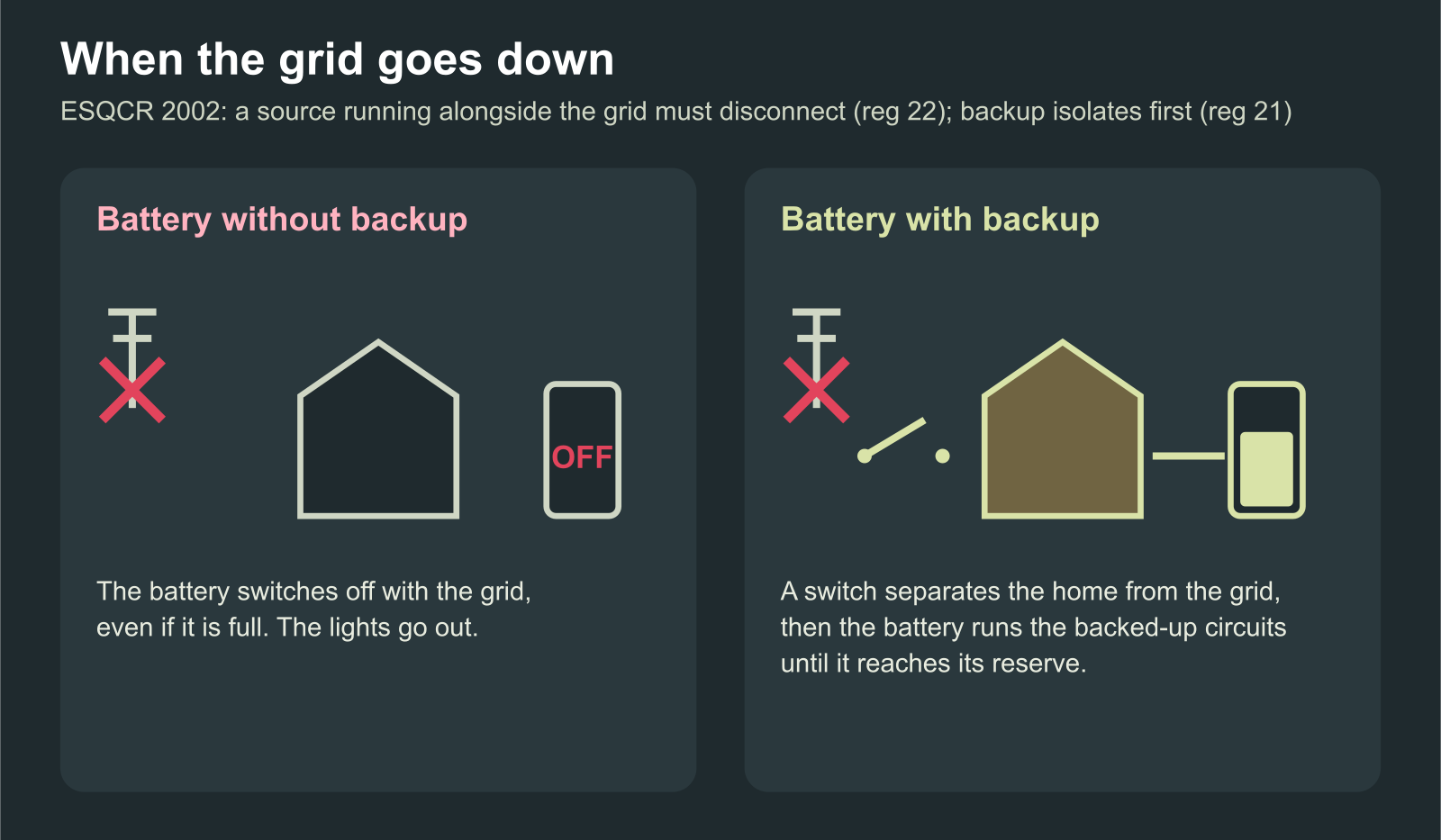
A home battery that runs alongside the grid must switch itself off when the grid supply is lost (ESQCR 2002, regulation 22), so without a backup function it does nothing in a power cut. Backup adds switching that separates your home from the network first, then runs chosen circuits until the battery reaches its reserve.
Why a battery switches off with the grid
Regulation 22 of the Electricity Safety, Quality and Continuity Regulations 2002 deals with sources of electricity that run in parallel with the network, which is what an ordinary home battery and solar system do. One of its requirements is that such a source disconnects itself when the network supply is lost.
The reason is the people repairing the fault. If homes kept feeding power back into lines that were meant to be dead, those lines would not be safe to work on. So the inverter watches the grid and, the moment it disappears, stops. That happens whether the battery is full or empty.
What a backup function adds
Regulation 21 covers the other arrangement: a switched alternative source, one that supplies the home only after it has been separated from the network, so the two can never run together. A battery with backup uses that principle. When the grid fails, a switch isolates your home (or part of it) from the network, and only then does the battery start supplying it again.
Backup comes in a few broad forms, and quotes don't always describe them the same way:
| Kind | What keeps working | Things to ask |
|---|---|---|
| None | Nothing; the battery switches off | Is backup possible later, and what would it involve? |
| A dedicated backup socket | Whatever you plug into that socket | What is its power limit in kW? |
| Essential circuits | Chosen circuits wired to a separate board, such as lights, fridge, router, boiler controls | Which circuits, and how much power can they draw together? |
| Whole home | All circuits, up to the backup output limit | What happens if the house asks for more than the limit? |
How long backup lasts
Three numbers decide it: the usable energy left above the reserve when the cut starts, the reserve setting itself, and the combined power of what you keep on. If the circuits ask for more power than the backup output can supply, the system can't run them all, however much energy is stored.
The estimator asks for your own figures, including the loads from appliance rating plates. Loads that cycle on and off, such as fridges and freezers, use less than their rating suggests on average, so a steady figure gives a cautious answer.
A reserve is the simplest way to make sure there is something left for a cut. The trade-off is that the reserved share isn't used day to day. Some systems let you change the reserve in the app, for example raising it when a storm is forecast.
For a sense of scale on whole-home backup, take Ofgem's medium figure for a single-rate home, 2,500 kWh a year. Spread evenly over every hour, that is an average load of about 0.29 kW, so each usable kWh above the reserve would last roughly three and a half hours, and 5 kWh about 17.5 hours (our arithmetic). Real use is lumpier than an average: cooking and hot water can lift the load far above it for short spells, and that is when the backup output limit, not the energy stored, decides what keeps running. If you are choosing a size with backup in mind, sizing in usable kWh works from the same evening figures.
Hours = stored energy above the reserve, divided by the load
Enter your battery's usable size, the charge it is likely to have, the reserve it keeps, and the combined power of the circuits you would keep on (from appliance rating plates).
Without a backup function the answer is zero: the battery switches off with the grid.
Backup, the wiring rules and the network
Regulation 21 has a second part that is easy to miss. Where the switched source forms part of a home's low-voltage installation, that installation must comply with the British Standard requirements the Regulations name for electrical installations. So the switch that cuts the home off from the network, the board for the chosen circuits and the battery's connections are designed and certified as part of the home's wiring, not plugged in afterwards. Ask how the design keeps the backed-up circuits safe while the home is cut off from the network, including how they are earthed during a cut, and where that shows on the certificate.
Backup can also change the network paperwork. MCS describes a fast-track G99 form for panels and storage fitted together, and one of its conditions is that the storage will not run when the grid fails. A system built to keep circuits going in a cut may therefore not fit that route, so ask which application will be made; G98 and G99 for a home battery covers the forms and their timing.
PAS 63100 asks for a notice saying a battery is present at the consumer unit or distribution board fed by the inverter, as well as at the origin of the installation. On a system with essential circuits, that can mean the separate backup board carries one too. Where the battery and its equipment may sit is set out in where to put a home battery.
Questions to settle before it is fitted
- Does the system have a backup function at all, and is it included in what is quoted?
- Which circuits would run in a cut, and are they the ones you care about, such as lights, the fridge and freezer, broadband, heating controls or medical equipment?
- What is the backup output limit in kW, and what happens if the house asks for more?
- How quickly does the system switch over, and will anything (such as a computer) notice the gap?
- What reserve will be set, and how can you change it?
Backup affects the wiring, so it is much easier to design in than to add later. It also has its own place in the electrical certificate. The specification guide shows where backup appears on a datasheet, and kW and kWh explains the power limit. If you rely on electrically powered medical equipment, don't rely on a home battery alone: talk to your electricity supplier and network operator about the support they offer.
What this page is based on
- Electricity Safety, Quality and Continuity Regulations 2002, regulation 22 (sources running in parallel with the network) (read 3 Nov 2026)
- Electricity Safety, Quality and Continuity Regulations 2002, regulation 21 (switched alternative sources) (read 3 Nov 2026)
- PAS 63100:2024, fire protection for battery energy storage in dwellings (BSI, sponsored by DESNZ), PDF (read 3 Nov 2026)
- IET and BSI announcement of Amendment 4 (2026) to BS 7671, the Wiring Regulations (read 3 Nov 2026)
- MCS guidance for installers on telling the network operator (G98 and G99) (read 3 Nov 2026)
- Ofgem decision on typical domestic consumption values (May 2026, in use from 1 July 2026), PDF (read 3 Nov 2026)
Questions about storage in your own home?
Tell us a little about your home and what you want a battery to do. Your message reaches SEO-DONS LTD, which publishes this guide, and we answer by email. It costs nothing to ask and commits you to nothing.
What happens next
- SEO-DONS LTD, the publisher of this storage guide, reads your message.
- We answer by email, using the same sources as the guide.
- What you do next, if anything, is up to you.