Where can a home battery go? PAS 63100 in plain words
A specification on exactly this question came into effect in March 2024. It is not law, but it is what a careful installer works to and what some schemes require, and it rules out several places people assume are fine.
In short
PAS 63100:2024 prefers an outdoor spot or a separate outbuilding. It rules out bedrooms and cupboards opening into them, escape routes such as halls, landings and stairs, lofts, roof spaces and voids, and cellars with no way outside. Other indoor rooms need fire separation, ventilation to outside and, in rarely visited places, an interlinked alarm.
What PAS 63100 is
PAS 63100:2024 is a specification on protecting homes against fire from battery energy storage systems. It was sponsored by DESNZ and published by BSI, and came into effect on 31 March 2024. It is reviewed at least every two years, and DESNZ awarded a contract to amend and review it in July 2026, so details may change.
Its scope is homes of up to 200 m² of floor area. It doesn't cover second-life batteries or high-risk residential buildings. It is a specification, not a law in itself, but Warm Homes: Local Grant requires battery work to meet it, and installers who follow it give you a written statement saying so.
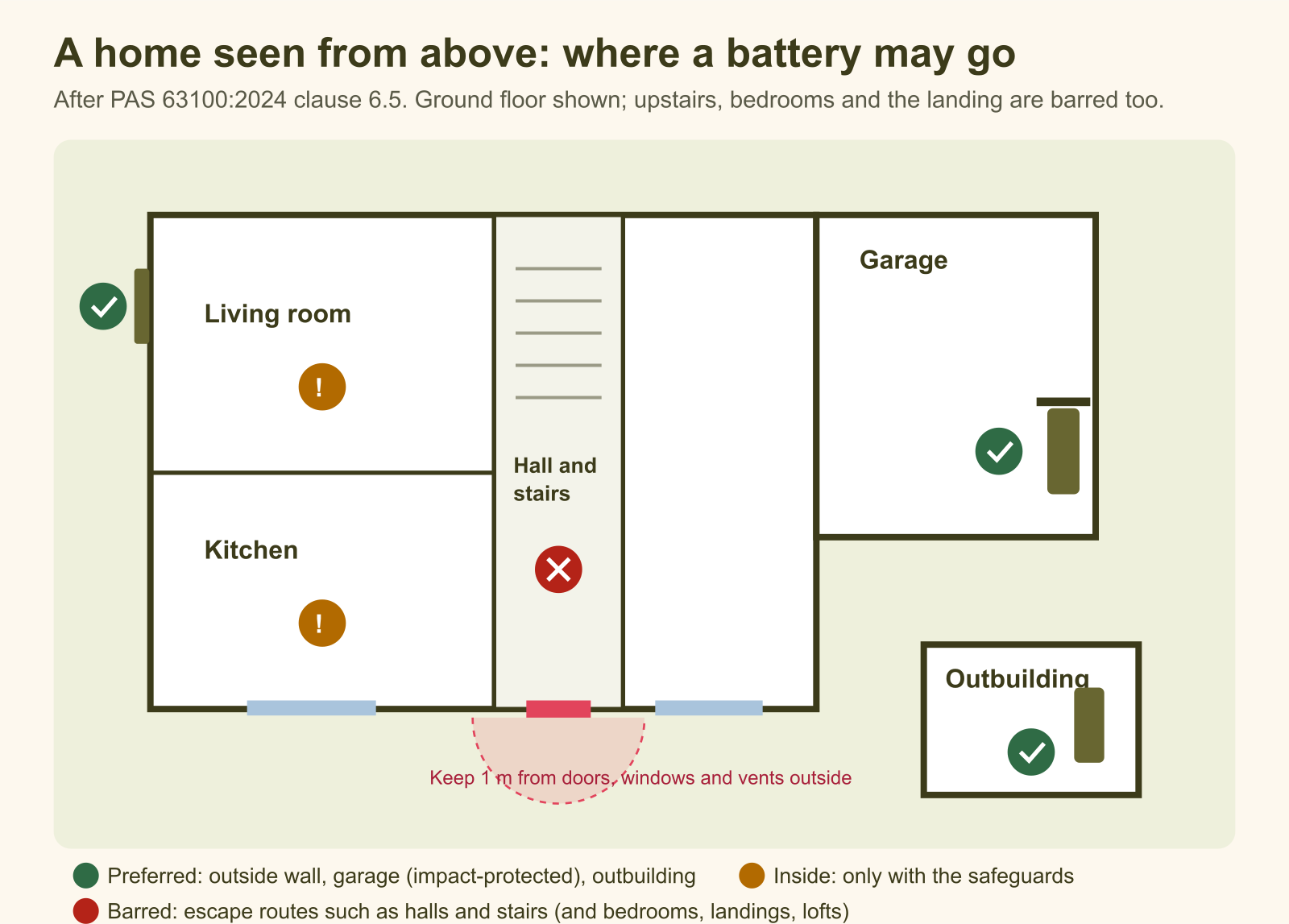
Location by location
| Location | Status | Conditions |
|---|---|---|
| Outdoors, on a wall or in the garden | Preferred where practicable (6.5.1) | At least 1 m from doors, windows, escape routes and ventilation openings (6.5.5 f) |
| Detached outbuilding, or one behind a REI 120 wall | Treated as outdoors (6.5.1) | Not near stored fuel or flammable materials (6.5.5 h) |
| Garage | Allowed | Impact protection to IK10 where vehicles could hit it (6.6); separation affects the storage cap |
| Other rooms indoors | Only with safeguards | Fire-resisting separation (REI 30), ventilation to outdoors, an interlinked alarm in rarely visited spots (6.5.3, 6.5.4, 6.5.6) |
| Bedrooms, and cupboards opening into them | Not allowed | 6.5.5 (a) and (e) |
| Escape routes: halls, landings, stairs, corridors | Not allowed | 6.5.5 (b), (c) and (d) |
| Lofts, roof spaces and voids | Not allowed | 6.5.5 (g) |
| Cellars or basements with no way outside | Not allowed | 6.5.5 (i) |
Why these places are ruled out
The pattern is about people getting out safely and fires being found early. Bedrooms are where people are asleep and slowest to notice a problem. Escape routes are how everyone leaves, so nothing that could burn or give off fumes belongs there. Lofts, roof spaces and voids are rarely visited, hard to reach and can let a fire spread unseen. A cupboard that opens into a bedroom brings the same risk into the room.
Safeguards for other indoor rooms
Where a battery goes indoors in a room that isn't ruled out, PAS 63100 asks for three things:
- Fire separation. At least REI 30 between the battery and the barred places, meaning construction that holds back a fire for 30 minutes.
- Ventilation. Fresh-air ventilation to the outside, with outdoor openings at least 1 m from doors, windows and other vents.
- An alarm. In rarely visited places such as a store cupboard, a smoke or multi-sensor alarm interlinked with the home's other fire alarms, to BS 5839-6.
Limits on how much energy can be stored
PAS 63100 also caps stored energy: no more than 20 kWh in one enclosure, and no more than 40 kWh in a home in most places. The limit rises to 80 kWh where the batteries are outdoors, in a detached garage or outbuilding, or in an attached garage separated from the house to REI 60. A large system therefore means more than one enclosure, and each needs a suitable spot. If you are still settling on a size, what size battery starts from your evening use.
Outside walls, garages and planning
An outside wall is often the obvious answer, but PAS 63100 says a wall-mounted battery must not weaken the wall's fire performance, and notes that in certain cases external equipment could need planning consent or a building-control notification. If your home is listed or in a conservation area, check with the council before agreeing a location. A garage works too, with impact protection where a car could hit the unit.
What you should receive at handover
- User instructions covering start-up and shutdown, alarms and fault codes, help and warranty contacts, how to shut the system down safely and what to do in a battery fire.
- The installer's statement of conformity with PAS 63100, attached to the electrical installation certificate under BS 7671, which since April 2026 includes a chapter on batteries.
Keep both with your home's paperwork; a future buyer, insurer or electrician may ask for them. Living with a home battery covers the handover in more detail, and storage for existing panels explains how location fits a retrofit.
The inverter has rules of its own
PAS 63100 treats the inverter, and any other equipment that converts the battery's power, in a separate clause from the battery. If an inverter goes in a loft, a store cupboard or another rarely visited spot, that spot needs its own smoke or multi-sensor alarm, interlinked with the rest of the home's alarms (7.2). Beside a driveway or parking space, inside a garage, or on a wall next to a public road, the inverter needs impact protection to IK08 and the battery to IK10 (7.3 and 6.6). The PAS also warns that barriers in some of those places can run into planning restrictions, and that another location is then the better choice.
Alarms for the whole home, not only the cupboard
The interlinked alarm in a rarely visited battery space is the minimum. A note to the clause that sets it (6.5.6) recommends that a home whose electrics include battery storage has a fire detection and alarm system of at least Grade D2, Category LD2 under BS 5839-6, which covers the escape routes plus any rooms that pose a high fire risk. In an existing home that can mean a new system, or an upgrade, when the battery goes in, and whoever designs it should make sure smoke or heat from a battery indoors would be picked up.
The battery's own warnings
The system has to raise the alarm itself as well. For a battery inside the home, a persistent dangerous condition, such as a high temperature that has not fallen two minutes after the battery was disconnected from the inverter, must give an audible warning as well as a visual one. A battery outdoors may rely on remote monitoring through an app instead (5.2). If yours will be outside, make sure its alerts reach someone who will act on them.
Notices on the electrics
Clause 8.2 asks for a notice showing that the home has battery storage, fixed in three places: at the origin of the electrical installation, at the meter if that is somewhere else, and at the consumer unit or distribution board the inverter feeds, which on a system with backup for power cuts may be a separate board. The example in the PAS reads "Battery in installation", with a second line where there are panels on the roof too. Check the notices are up before the installer leaves.
When the rules change
PAS 63100 is reviewed at intervals of no more than two years, and the amendment DESNZ contracted in 2026 may change details. We re-read it before republishing any of the rules on this page, and the date at the top says when we last did.
What this page is based on
- PAS 63100:2024, fire protection for battery energy storage in dwellings (BSI, sponsored by DESNZ), PDF (read 3 Nov 2026)
- Find a Tender: DESNZ contract to amend and review PAS 63100 (award notice, July 2026) (read 3 Nov 2026)
- DESNZ Warm Homes: Local Grant policy guidance (July 2026), PDF (read 3 Nov 2026)
- IET and BSI announcement of Amendment 4 (2026) to BS 7671, the Wiring Regulations (read 3 Nov 2026)
Questions about storage in your own home?
Tell us a little about your home and what you want a battery to do. Your message reaches SEO-DONS LTD, which publishes this guide, and we answer by email. It costs nothing to ask and commits you to nothing.
What happens next
- SEO-DONS LTD, the publisher of this storage guide, reads your message.
- We answer by email, using the same sources as the guide.
- What you do next, if anything, is up to you.