Battery storage for solar panels you already have
Adding storage to a working solar system is the most common way homes end up with a battery. The panels stay as they are; the questions are how the battery connects, how big it should be and what else changes.
In short
Storage can be added to existing panels in two ways: an AC-coupled battery with its own inverter beside the solar inverter, or a hybrid inverter that replaces the solar inverter and runs both. Size it from last year's export and your evening use, not from the panels' kWp, and expect the combined system to need a G99 application.
Two ways to connect it
Panels produce direct current (DC); your home runs on alternating current (AC). Your existing solar inverter does that conversion. A battery also stores DC, so the question is where it joins the system.
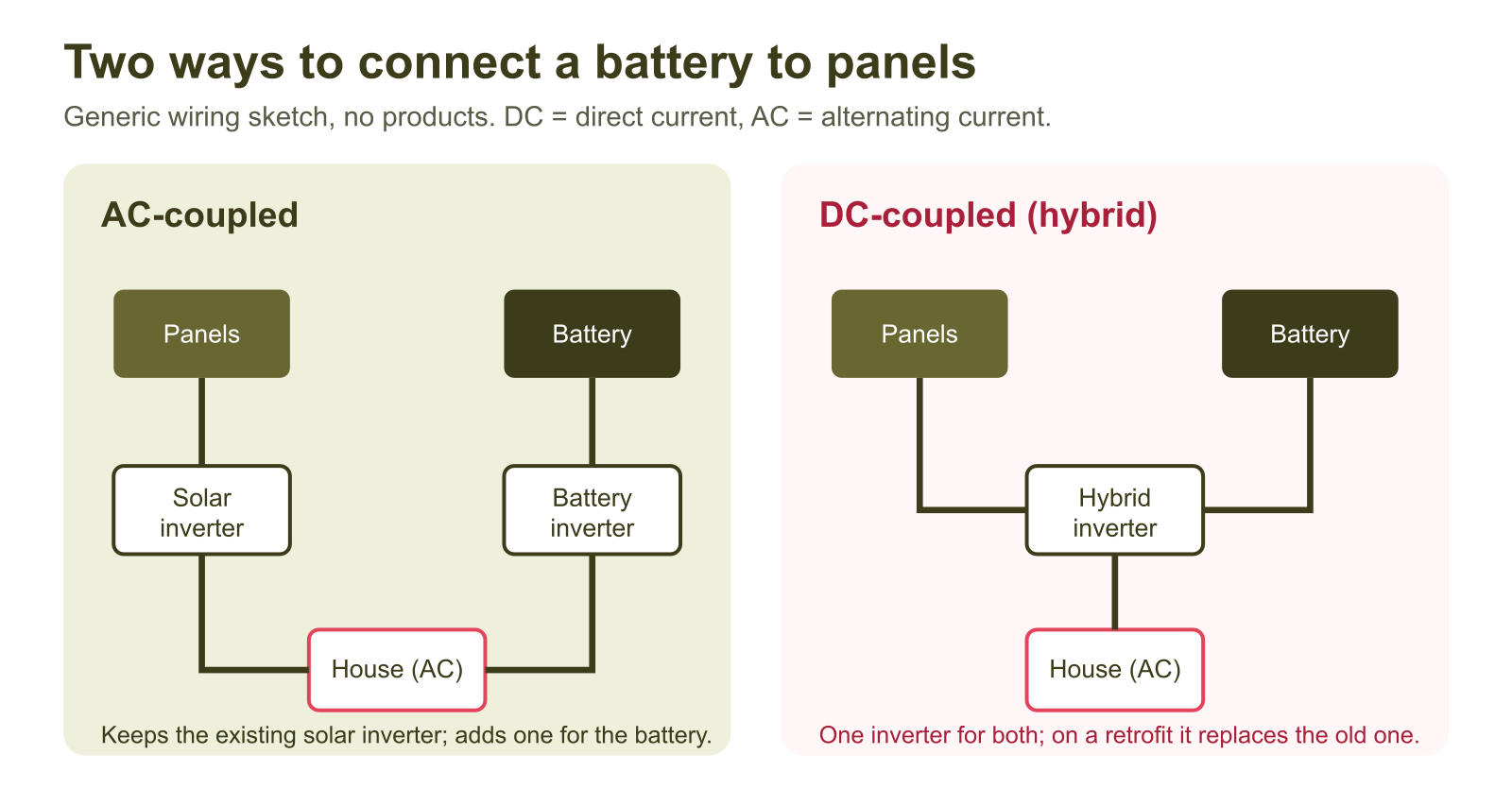
AC-coupled: a second inverter
The battery comes with its own inverter and connects on the home's AC side, next to the existing solar inverter, which stays exactly as it is. The two work side by side: the solar inverter turns sunlight into AC for the house, and the battery inverter turns surplus AC back into DC to store, then into AC again when the house needs it.
DC-coupled: one hybrid inverter
A hybrid inverter handles panels and battery together, so solar can charge the battery as DC without converting twice. On an existing system that usually means taking the old solar inverter off the wall and rewiring the panels to the new unit.
Which route suits an existing system?
| AC-coupled | Hybrid (DC-coupled) | |
|---|---|---|
| Existing solar inverter | Kept | Usually replaced |
| Conversions for stored solar | DC to AC, then AC to DC to store, then back | DC straight into the battery, then to AC |
| Work on the panels' wiring | Little or none | Panels rewired to the new inverter |
| Suits | A young, working solar inverter | An inverter near the end of its life |
| Worth asking | How the two inverters' settings will be coordinated | What happens to the old inverter's warranty and monitoring |
The government's Warm Homes Loan Scheme rules list "integration with existing PV system" among the things a battery quote may include, and the Wiring Regulations' 2026 amendment added a chapter on batteries that covers inverters handling two-way flows. Both are reminders that connecting storage to an existing system is real electrical work, not a plug-in extra.
Use last year's export to size it
The single most useful number you have is how much solar you exported last year. It is on your export meter or your Smart Export Guarantee statements. That figure is the pool a solar-fed battery could draw on: a battery can only store surplus, and last year's surplus is the best guide to next year's.
Divide it by 365 for a daily average, then remember the seasons. Leicester's PVGIS profile gives about 3.88 kWh per kWp on a June day and 1.10 in December, so summer days produce several times the surplus of winter ones. A battery that would catch all of a June afternoon's export may hold very little in December.
Then set that against your evening and night use, which is what the battery can actually supply. The smaller of the two is a sensible usable size to start from. Our sizing helper does the arithmetic with your own figures, and the explorer on the home page shows how much more of your solar would stay at home in year one if you put in the self-use shares from a quote.
If your panels earn Feed-in Tariff export payments
GOV.UK's guidance says SEG export payments are not available alongside Feed-in Tariff export payments. If your system is on the older scheme, ask your FiT supplier how adding storage affects your arrangement before any work is done, and keep the answer in writing.
What else changes when storage is added
The network notification
Your panels were notified to the network operator when they went in. Adding storage changes what is connected. Network operators treat a battery as demand when it charges and as generation when it exports, and MCS notes that panels plus a battery will often be above the 16 A per phase limit for the simpler G98 route, which puts the job under G99, applied for before installation. See telling the network about a battery.
Where the battery goes
The panels are on the roof, but the battery must go somewhere PAS 63100 allows: not a loft, bedroom or escape route, and preferably outdoors or in a separate building. Existing homes rarely have an obvious spot, so this is often the deciding practical question. Where to put a home battery goes through the rules.
The certificates
Battery storage is a separate MCS technology from solar panels, with its own installation standard (MIS 3012). An installer certified for your panels is not automatically certified for batteries: check the firm's entry on the MCS register lists battery storage. At handover you should receive an electrical certificate, a statement that the battery installation conforms to PAS 63100, and user instructions covering shutdown and what to do in a battery fire.
Backup
Adding a battery does not by itself keep the lights on in a power cut; that needs a backup function. If backup matters to you, say so before the design is agreed, because it affects the wiring. Backup in a power cut explains the options.
Older systems and the age of the inverter
Solar inverters work hard and tend to be the first part of a system to need replacing. If yours is approaching the end of its life, a hybrid inverter that runs both panels and battery can replace it as part of adding storage, which is one reason the hybrid route is often proposed for older systems. If it is young and working well, an AC-coupled battery leaves it alone. Either way, ask the installer to record the existing inverter's make, model and age on the quote, and to say whether the panels' wiring and isolators need any work to meet the current Wiring Regulations once storage is added.
Monitoring is worth asking about too. Two inverters may mean two apps; a hybrid usually means one. Being able to see solar, house, battery and grid flows in one place makes it far easier to check the battery is doing what the design intended.
What this page is based on
- DESNZ Warm Homes Loan Scheme rules, version 3 (September 2026), PDF (read 3 Nov 2026)
- IET and BSI announcement of Amendment 4 (2026) to BS 7671, the Wiring Regulations (read 3 Nov 2026)
- GOV.UK guide to the Smart Export Guarantee (read 3 Nov 2026)
- PVGIS, the EU Joint Research Centre solar estimator (annual and monthly yields) (read 1 Nov 2026)
- MCS guidance for installers on telling the network operator (G98 and G99) (read 3 Nov 2026)
- PAS 63100:2024, fire protection for battery energy storage in dwellings (BSI, sponsored by DESNZ), PDF (read 3 Nov 2026)
- MCS Installer Operating Requirements (2026), technologies and use of the MCS mark, PDF (read 2 Nov 2026)
- MCS public register of certified installers (read 3 Nov 2026)
Questions about storage in your own home?
Tell us a little about your home and what you want a battery to do. Your message reaches SEO-DONS LTD, which publishes this guide, and we answer by email. It costs nothing to ask and commits you to nothing.
What happens next
- SEO-DONS LTD, the publisher of this storage guide, reads your message.
- We answer by email, using the same sources as the guide.
- What you do next, if anything, is up to you.